
Brake Repair in Charlotte
Fast, Honest Brake Fixes Where Your Car Is Located
Brake repair in Charlotte. North Carolina inspects the foot brake and the parking brake every year, and a safety item cannot be waived. If your brakes will not pass, your registration will not renew. Mobile brake repair across Mecklenburg County. Call 704-741-4749.
Brake Repair and the North Carolina Safety Inspection
Brake repair in Charlotte is not only about how the car feels. It is tied directly to whether you can keep the car registered.
North Carolina requires a vehicle to pass an annual safety inspection before its owner can renew the registration. The inspection can be done no more than 90 days before the plate is due, and if it is not done by the due date, the registration is blocked until it is. There is no grace period that lets you keep driving on an out-of-date plate while you sort the brakes out.
The state lists what a licensed mechanic examines: headlights, accessory lights, directional signals, the foot brake, the parking brake, steering, tires, the horn, the rearview mirror, windshield wipers, the exhaust system and emission control components.
Two of those twelve are brakes.
The Line That Matters Most
North Carolina publishes a waiver route for emissions failures. If a vehicle passes safety but fails the on-board diagnostic emissions check, the owner can document at least 200 dollars of repairs, have it re-inspected, and take the paperwork to the State Highway Patrol Investigative Services Unit for a waiver.
No equivalent exists for brakes. The state says it plainly: all safety items must pass, and a waiver cannot be issued for the failure of a safety item.
That single sentence is why brake repair sits in a different category from most other work on a car. A check engine light has a documented path that ends in a waiver. A brake failure has one path, and that is repair.
The Foot Brake and the Parking Brake Are Separate
Drivers are often caught out by this. The service brake and the parking brake are inspected as two distinct items, and a car can pass one while failing the other.
The service brake has to stop the vehicle without pulling to one side and without unusual noise. A car that veers under braking fails, even if it stops in a reasonable distance, because pulling means one corner is not working properly.
The parking brake has to hold the vehicle on a moderate incline. This is the one that surprises people, because a parking brake that is never used corrodes and seizes without the driver noticing a thing. If you always leave an automatic in Park and never touch the lever or the switch, there is a fair chance yours will not hold when it is tested.
What We Repair Before an Inspection
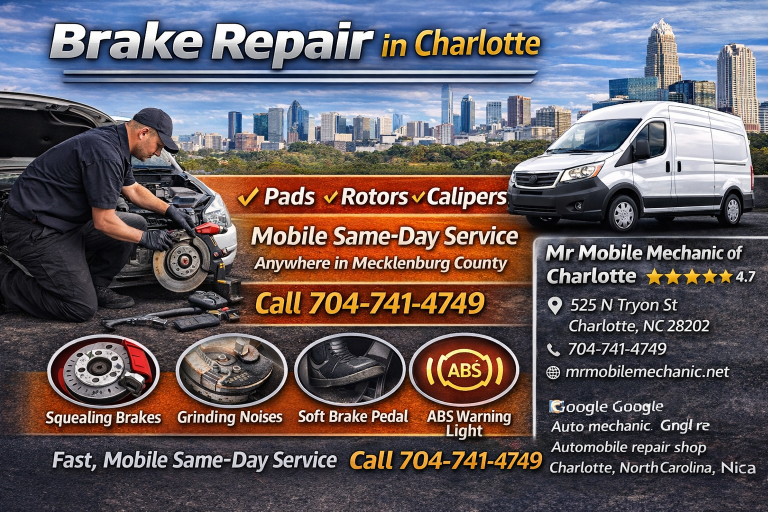
Brake repair ahead of an inspection covers pads and rotors where measurement shows they are past limit, caliper replacement or rebuild where one is sticking and causing a pull, flexible hose replacement where a hose has cracked or collapsed internally, fluid flush where the fluid has absorbed moisture, parking brake cable and adjustment work, and ABS diagnosis where a warning light is present.
The last one matters because a lit ABS warning is a failure item on a vehicle built with the system. An ABS light that has been on for a year is not something an inspector overlooks.
All of it happens where the car is parked. You do not need to drive a car with brake faults across town to fix the reason it should not be driven across town.
The 90 Day Window and How to Use It
An inspection cannot be carried out more than 90 days before the plate and registration come due. That window is the useful part, because it gives you room to fix a problem without the registration being blocked.
The practical approach is to get the brakes looked at early in the window rather than in the final week. If pads measure close to limit, you know before the inspection rather than after a failure, and the repair is a planned visit instead of an emergency one. A car that fails on the last available day leaves you with a blocked registration and an unrepaired car at the same time.
Vehicles Over 30 Years Old
North Carolina exempts vehicles more than 30 years old from the annual safety inspection, and vehicles carrying an antique automobile license plate are exempt from both safety and emissions inspections. Antique plates are intended for vehicles used mainly for exhibitions, club activities, parades and similar events.
An exemption from inspection is not an exemption from physics. An older car that is genuinely driven still needs brakes that work, and older brake systems bring their own issues: single-circuit master cylinders on the oldest vehicles, rubber hoses that have aged past their useful life regardless of mileage, and drum hardware that seizes when a car sits.
Why a Mobile Repair Helps Here Specifically
There is a circular problem with brake failures. The car needs repair before it can pass, but the repair is usually somewhere you have to drive the car to reach, and the reason it failed is that the brakes are not right.
Repairing at the car removes that loop. The work happens in your driveway, your workplace lot or a parking deck, and the car only moves once the brakes are correct.
It also removes the second trip. A shop visit is typically two journeys and a wait between them. If the inspection deadline is close, the wait is the expensive part.
Common Brake Failures on Charlotte Cars
Pads worn past the minimum thickness are the most frequent, and the most preventable, because the wear indicator usually gives weeks of audible warning first.
Rotors below minimum thickness are next. A rotor has its minimum stamped on the hat, and once it measures below that figure it cannot be reused or machined. This is why replacing pads and ignoring rotors sometimes turns into a larger job than expected.
A seized caliper causing a pull shows up regularly on cars that sit for long periods, which includes plenty of second vehicles and cars belonging to people who mostly work from home.
Parking brakes that will not hold are common in a city where most drivers have automatic transmissions and never touch the lever.
An illuminated ABS light is the failure people are most often surprised by, because the car stops normally in everyday driving and the light has simply become part of the dashboard.
Mecklenburg Has a Second Inspection Too
Worth knowing while you are planning. Mecklenburg is one of only 19 North Carolina counties out of 100 where a vehicle must also pass an on-board diagnostic emissions inspection, carried out at the same time as the safety inspection. Neighbouring Union, Gaston, Cabarrus, Iredell and Lincoln are on that list as well.
So a Charlotte vehicle faces both checks in one visit. If the brakes fail and the check engine light is on, those are two separate problems with two different rulebooks, and only one of them has a waiver route.
Related Brake Pages
For what the van carries and what can be done at the curb, see brake shop in Charlotte. To work out what a noise means, see brakes in Charlotte. For the replace against resurface decision, see auto brake replacement Charlotte.
Brake Repair Before Your Inspection
If your plate is due and you already know the brakes are not right, get them measured before the inspection rather than after a failure. Safety items have no waiver route in North Carolina, so the repair has to happen either way.
Call 704-741-4749. Mobile brake repair anywhere in Mecklenburg County.
Reliable and trustworthy mobile mechanic service!
Are you looking for a reliable mechanic to come to your place and help you with repairs on spot? –We are here to Help!



Copyright © 2026. Mr Mobile Mechanic. All rights reserved
This service sits under Brake Shop Charlotte, part of Mobile Mechanic Charlotte NC. For related work, see Auto Brake Repair Charlotte.