
Auto Repair Shop In Charlotte
Fast, Honest, On-Site Mobile Auto Repair Shop In Charlotte NC
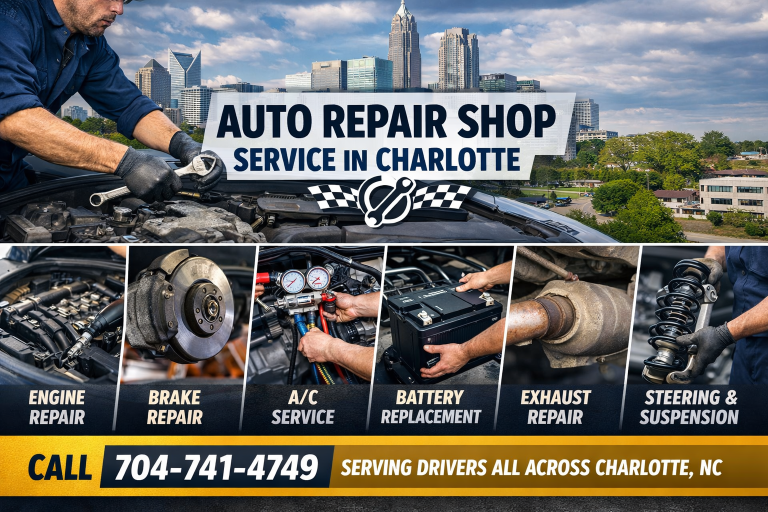
Auto repair shop work in Charlotte. Some jobs genuinely need a building, a lift and fixed equipment. This page is an honest account of which ones, and how mobile service and workshop work fit together. Call 704-741-4749.
What a Building Actually Provides
Worth setting out plainly, because the difference is specific rather than general.
A vehicle lift raises the whole car to working height and leaves the underside fully accessible. Jacks and stands raise one corner or one end safely, which covers a great deal of work but not everything.
Fixed equipment. A wheel alignment rig, a tire changer and balancer, a press for bearings and bushings, a parts washer, a welder, and air tools running from a large compressor. None of those travel.
Controlled conditions. A dry, lit, level floor with power, and the ability to leave a vehicle partly dismantled overnight while a part arrives.
That last point is the one most often overlooked. A driveway job has to be finished in one visit, because a car cannot be left apart on a public street or blocking a family’s parking.
The Jobs That Need It
Said clearly so nobody is told halfway through a repair.
Internal engine work: head gaskets, timing chains on most engines, bearings, pistons, rings, valves, and anything requiring the engine out.
Transmission removal, clutch replacement and internal transmission rebuilds.
Full exhaust system replacement, and any welded exhaust repair.
Fuel tank removal.
Wheel alignment, which needs the fixed rig, and tire mounting and balancing.
Pressed components: many wheel bearings, and control arm bushings that are pressed rather than bolted.
Evaporator and heater core replacement, which requires the dashboard removed on nearly every vehicle.
Suspension work where fasteners have corroded to the point of needing heat or cutting, which happens in a city that treats its roads with brine at around 23 percent salt.
Anything on a vehicle stopped somewhere unsafe to work, where the right answer is moving it first.
The Jobs That Do Not
A larger list than most people assume, and this is the point.
Brakes in full: pads, rotors, calipers, flexible hoses, fluid flush, parking brake adjustment, ABS diagnosis.
Batteries, alternators and starters. Charging system and electrical diagnosis, wiring repairs, module communication faults.
Cooling systems: thermostats, water pumps on many engines, hoses, radiator caps, fans, coolant flushes, pressure testing.
Air conditioning: diagnosis, leak detection, evacuation and recharge, compressor and condenser work on most vehicles.
Servicing throughout: oil and filters, both air filters, plugs, belts, all fluids, inspections.
Suspension and steering: struts and shocks on most designs, ball joints, tie rod ends, sway bar links, hub-type wheel bearings, CV axles.
Engine work that stays external: sensors, coils, injectors on port-injected engines, gaskets and seals accessible from outside, exhaust manifold gaskets on many engines.
Diagnosis of anything at all, including compression and leak-down testing, which is what determines whether a job belongs on the list above or this one.
Why the Diagnosis Is Worth Having Either Way
When a fault turns out to need a workshop, the diagnosis already done is not wasted.
Knowing precisely what is wrong changes the conversation with whoever does the work. It also prevents paying twice for the same investigation, and it means a decision about whether the repair is worth doing can be made before committing to anything.
On an older vehicle that last point matters most. A compression and leak-down test performed in your driveway establishes whether an engine is mechanically sound apart from the known fault or worn throughout. That single piece of information often decides whether a car is worth a major repair, and it costs a fraction of finding out afterwards.
Time Is the Real Difference
For most owners the decision is not about capability, it is about the day.
A workshop visit is two journeys, a wait or a lift arranged with someone, and time fitted around opening hours. In a city where more than 577,000 people commute an average of around 28 minutes each way, that is genuinely difficult to arrange, and it is the reason maintenance gets deferred.
Deferred maintenance is what produces the repairs. A brake fluid flush missed for years, a coolant change skipped, a transmission fluid never looked at: each is a small job avoided because of the logistics rather than the cost, and each has a larger consequence later.
Work done at your home or workplace removes the logistics entirely. The car sits where it was going to sit anyway.
Where the Vehicle Needs to Be
Mobile work has practical requirements, and being clear about them saves a wasted visit.
Reasonably level ground. A steeply sloped driveway is not a safe place to lift a car, and the work moves to the flattest available spot.
Enough room to work at the relevant corner or in the engine bay, and to open doors and a hood.
Permission where the location is not yours. Workplace lots usually need a word with facilities, and Charlotte parking decks are privately managed and normally need the attendant or building desk informed. Decks are otherwise excellent, being flat and sheltered, though the posted clearance height at the entrance matters for the service van and is worth confirming when booking.
Weather tolerance. Heavy rain moves fluid work under cover or reschedules it, because an open brake or coolant system and a Charlotte thunderstorm are a poor combination.
Being Told Before, Not After
The commitment that matters most is honesty about which category a job falls into.
A car left partly dismantled in a driveway because a job turned out to need equipment that was not there is worse than never starting. So where a diagnosis points at workshop work, that gets said before anything is taken apart, along with what the job involves and roughly what is required.
Similarly, where a fastener is clearly going to need heat rather than force, stopping and saying so is better than snapping a control arm bolt and leaving a car immobile.
Related Pages
For a fuller comparison, see auto repair shops against mobile mechanics. For what a mobile visit covers, see mobile mechanic in Charlotte. For choosing who does the work, see mechanic in Charlotte.
Charlotte Auto Repair, Workshop or Mobile
Most repairs do not need a building. Where yours does, we will tell you that before anything is taken apart, and the diagnosis still saves you paying for it twice.
Call 704-741-4749. Mobile auto repair across Mecklenburg County.
Reliable and trustworthy mobile mechanic service!
Are you looking for a reliable mechanic to come to your place and help you with repairs on spot? –We are here to Help!



Copyright © 2026. Mr Mobile Mechanic. All rights reserved
Our auto repair shop work in Charlotte covers Auto Exhaust System Repair Charlotte, Engine Repair Charlotte, Steering & Suspension Replacement Charlotte, Clutch Replacement Charlotte, Detailed Inspection Charlotte, Carburetor Cleaning Charlotte. Back to Mobile Mechanic Charlotte NC.